Blog
Thinking
What running a marathon taught me
by
Paige Johnson
April 23, 2026
What running a marathon taught me
I’ll be turning 29 this year, firmly hurtling towards the end of my 20s, so naturally, like many people side-eyeing their 30s, I decided to run a marathon. (It was that or buy a house, and I live in London, so that’s not happening any time soon.)
Jokes aside, this is something I’ve always wanted to do. I’ve run six half marathons over the years, and the full distance has always lingered in the background. More so, it was one of those things you say you’ll do “one day,” but never quite get around to.
This year, I decided to stop talking about it and just do it. Nike pun not intended.
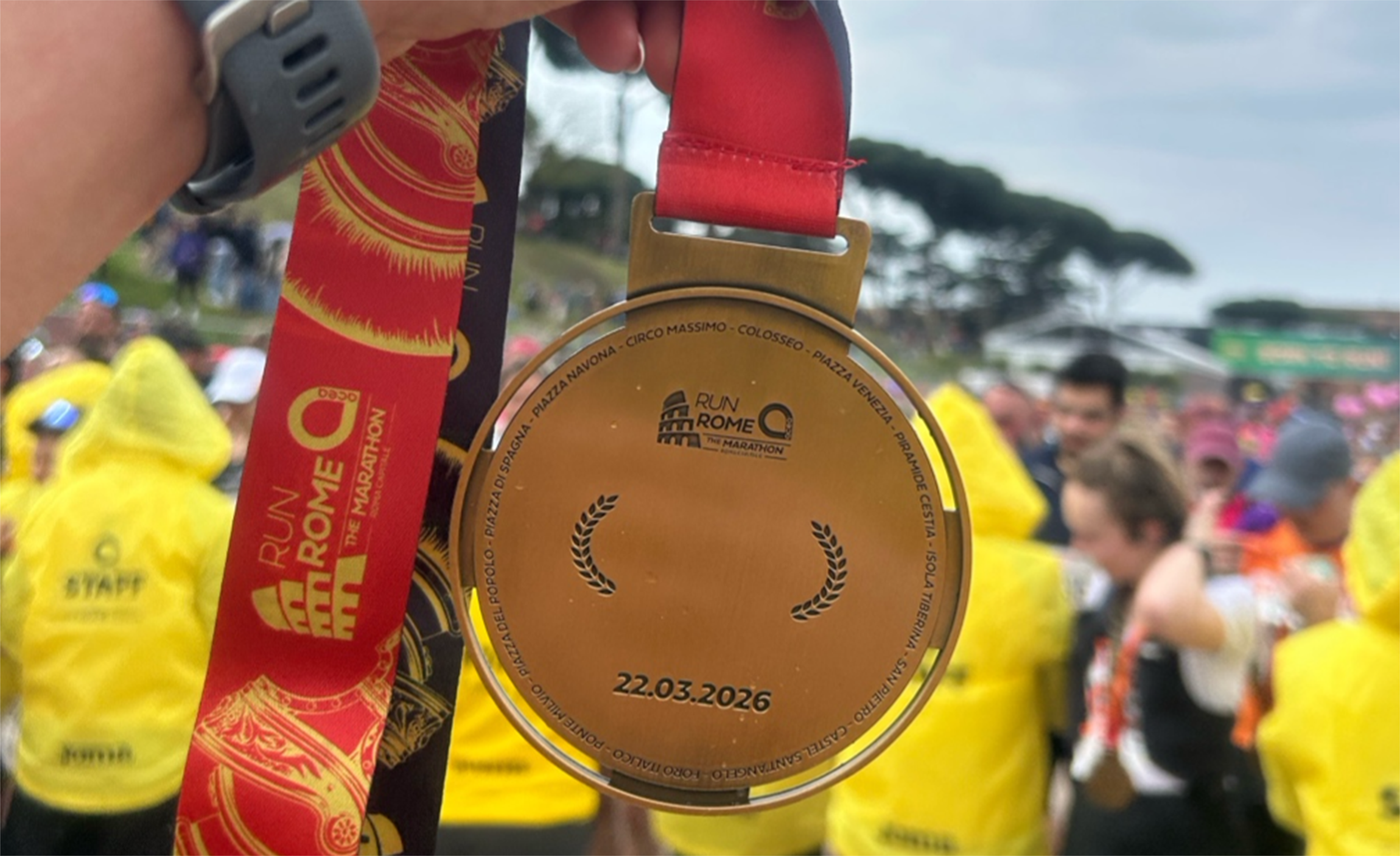
Twenty weeks of training, more carbs than felt reasonable, and a handful of physio appointments all culminating in 4 hours and 29 minutes of running and, genuinely, one of the best experiences I’ve ever had.
As cliché as it sounds, I’m not the same person I was before I started the long road to the Rome Marathon. Somewhere between the early alarms, the runs in freezing conditions, and countless hours of Spotify, something shifted.
Part of the reason I signed up was to prove to myself that I can do hard things. To quiet that doubting voice in my head that says I can’t. Because if I can run a marathon, what can’t I do?
A sense of pride has settled within me that I’ve previously found hard to grasp. Beyond that, I feel mentally tougher, more resilient and more certain in my ability to achieve.
So, I wanted to share a few things running a marathon has taught me. Lessons I’ll be taking far beyond race day and into everyday life.
Things are rarely as bad as you think
I’d heard marathon training was brutal. That I’d lose my life to pounding the pavement. That I’d be permanently tired, permanently hungry, slightly miserable, and forever turning down plans because of a long run the next morning.
I found quite the opposite. I genuinely enjoyed the training. I looked forward to my long runs and the satisfaction of ticking off a distance further than the last.
It also made me far more intentional with my time. I swapped unnecessary evenings in the pub for post-run feasts, long walks, coffee catchups, and sometimes even runs with friends. I started prioritising my health, paying more attention to what I was eating, sticking to a proper sleep routine, and actually listening to my body. As a result, I had more energy, I was more present and felt more like myself.
Then there’s the actual marathon.
In the weeks leading up to it, I started doubting everything. I’d missed a couple of long runs due to injury and hadn’t gone beyond 30 km. In my head, that completely overshadowed all the training I had done.
I’d seen so many videos of people hitting “the wall” that it started to feel personal, like a targeted attack on my confidence. I was convinced it was inevitable. That at 30 km, my legs would seize up, I’d be in tears, and I’d be crawling to the finish.
The reality? I loved it. Completely loved it.
Okay, there were moments towards the final kilometres when it was hilly, cobbled, and raining (a truly humbling combination) that I didn’t fully enjoy, but overall, it was incredible. The atmosphere. The crowds. The feeling of being part of something bigger than yourself. The steady realisation that you’re actually doing it, that your body is carrying you through 42.195 km.
The first 30 km flew by. I was smiling, taking it all in, but still bracing myself, thinking, “I’m going to crash soon.” I’d saved my music and a caffeine gel for that point. A bit of Barry Can’t Swim, the gel kicking in, and suddenly I felt like I was flying. To the point I had to slow myself down because my heart rate was creeping up.
The wall never came. When I crossed the finish line, I couldn’t quite believe it. It went so quickly. It wasn’t as hard as I’d built it up to be, and I’d had the best time.
I’m a chronic overthinker. My brain defaults to worst-case scenario. But this experience forced a mindset shift. It made me realise how often we amplify things in our minds before they even happen.
How we turn challenges into something far bigger and more intimidating than they need to be. The run, the meeting, the difficult conversation, the new challenge, we put ourselves through it twice: once in anticipation, and once in reality. Often, the version in our heads is worse than the real thing.
Marathon training taught me that if you’ve put the work in, you can trust it. You can trust yourself because the hardest part usually isn’t the thing, but convincing yourself you’re capable of it in the first place.
Now, that voice in my head that constantly asks, “What if it all goes wrong?” has something to answer it with: What if it all goes right?
Sometimes the journey is more important than the destination
The marathon itself is one day. One long day, but still just a day. Training, on the other hand, takes months. Months of structure, routine, gradual progress, and small wins that stack up over time. That’s where the real value was. Race day was incredible, but it was the training that changed me.
Showing up for myself consistently and seeing improvements week after week was genuinely life-affirming. Not because of any one run, but because of the accumulation of all of them. Proof that small, consistent effort actually leads somewhere.
It was the freezing 7 am runs before work. The sessions where I felt tired, busy, or unmotivated, but showed up anyway. That’s the part that translates far beyond running.
It’s easy to fixate on the end goal, thinking everything will click into place once you get there. The reality is much less about the big moment and much more about the smaller moments in between.
The unglamorous work. The consistency. The discipline to keep going when there’s no immediate reward or recognition. The process you commit to and the habits you build along the way are what change who you are and what you’re capable of achieving.
Preparation is key
Coming from a scientific background, I like to research everything I do, and the marathon was no different. I looked up optimum training schedules, strength exercises, fuelling strategies, the best trainers to wear, the exact amount of carbs needed for a carb load (to the gram, weighed out), and treated my Garmin stats as if they were my vitals.
I was taking evidence-backed supplements, drinking beetroot juice (it really does work!), and drinking so much water that bathroom breaks became a full-time job. I watched countless marathon videos, noting where people had gone wrong and what I could do differently.
I wanted to be as prepared as possible so I could give it my all and give myself the best chance of completing the marathon.
Come race day, my body felt strong, I didn’t crash, and a huge part of that was the preparation I’d put in. I went in with a clear plan, well-fuelled and hydrated, and finished with energy to spare, no cramping, and a smooth recovery (minus one black toenail).
When doubts crept in during training, the evidence behind everything I was doing gave me confidence. On the morning of the race, I woke up with a sense of calm and felt I’d done everything I could do.
Preparation is the difference between winging it and excelling. It’s about giving yourself the space to perform at your best, to handle the unexpected, and to enjoy the process rather than being overwhelmed. When you invest in the work beforehand, you gain certainty, clarity, and freedom to focus on what matters in the moment.
If a task feels too big, break it up
When I first signed up, the distance felt overwhelming. I’d done half marathons, yes, but doubling that distance? No idea how I’d manage. Then I saw someone suggest breaking it into smaller chunks.
At first, I didn’t think it would work. Surely I’d always be aware of the full distance looming ahead. However, during training, a lot of my runs were split into different sections for different paces, and I found they were flying by.
On race day, I divided the marathon into 4 x 10 km and a final 2.2 km. I even set my Garmin to count down each 10 km, and I had a plan for each section: the first 10 km I soaked it all in, the second and third I listened to podcasts, and the final 10 km I switched to music. By focusing only on the section in front of me, I never thought about the full distance. I just kept saying, “I can do 10 km,” and before I knew it, I was at the next milestone. The race went by surprisingly quickly.
This is by no means groundbreaking advice. I’ve read countless productivity tips about breaking things into manageable chunks, but experiencing it firsthand made me finally take stock.
Whether it’s running, writing, or tackling a big project, breaking it down makes it feel more achievable. You trick your brain into focusing on the next step instead of being overwhelmed by the full task. Don’t start with a 1,000-word target; write 100 words at a time. Instead of fixating on a to-do list, focus on the next task. It’s a simple mindset shift, but it makes all the difference.
Would I do It again?
Without hesitation. I finished with a massive smile and the immediate urge to sign up for another one. I guess I’ve caught the bug.
Not just for the race itself, but for everything that comes with it: the structure, the discipline, the unexpected enjoyment, the confidence that builds over time, and the reminder that you are capable of more than you think (even if it took me 20 weeks of training to prove it).
Maybe running a marathon might have been an extreme way to learn these lessons, and I’m not pretending that I’m suddenly some perfect person who has everything figured out, but it has shaped me in a meaningful way.
Everyone has their own “marathon” to run. It could be a long bike ride, a swim, a career challenge, or even a personal goal you’ve been putting off. The lesson is the same: if you put in the work, step by step, and give yourself the chance to grow along the way, what once felt impossible becomes achievable. Trust me, if I can do it, you can too.
By Paige Johnson | Senior Medical Copywriter